Over the past decade, Zephyr has evolved from an emerging real-time operating system into a foundational platform for modern embedded development.
A new Linux Foundation Research report, Zephyr® Turns 10: A Decade of Adoption, Maturity, and Ecosystem Evolution, created in partnership with LF Research, Zephyr, and Intel, examines Zephyr’s adoption, technical footprint, and ecosystem dynamics.
Drawing on survey data and qualitative interviews, the report finds that Zephyr has reached a stage of operational maturity. It is widely deployed in production environments with constrained hardware, long product lifecycles, and a need for portability across heterogeneous platforms.
The State of Zephyr After 10 Years
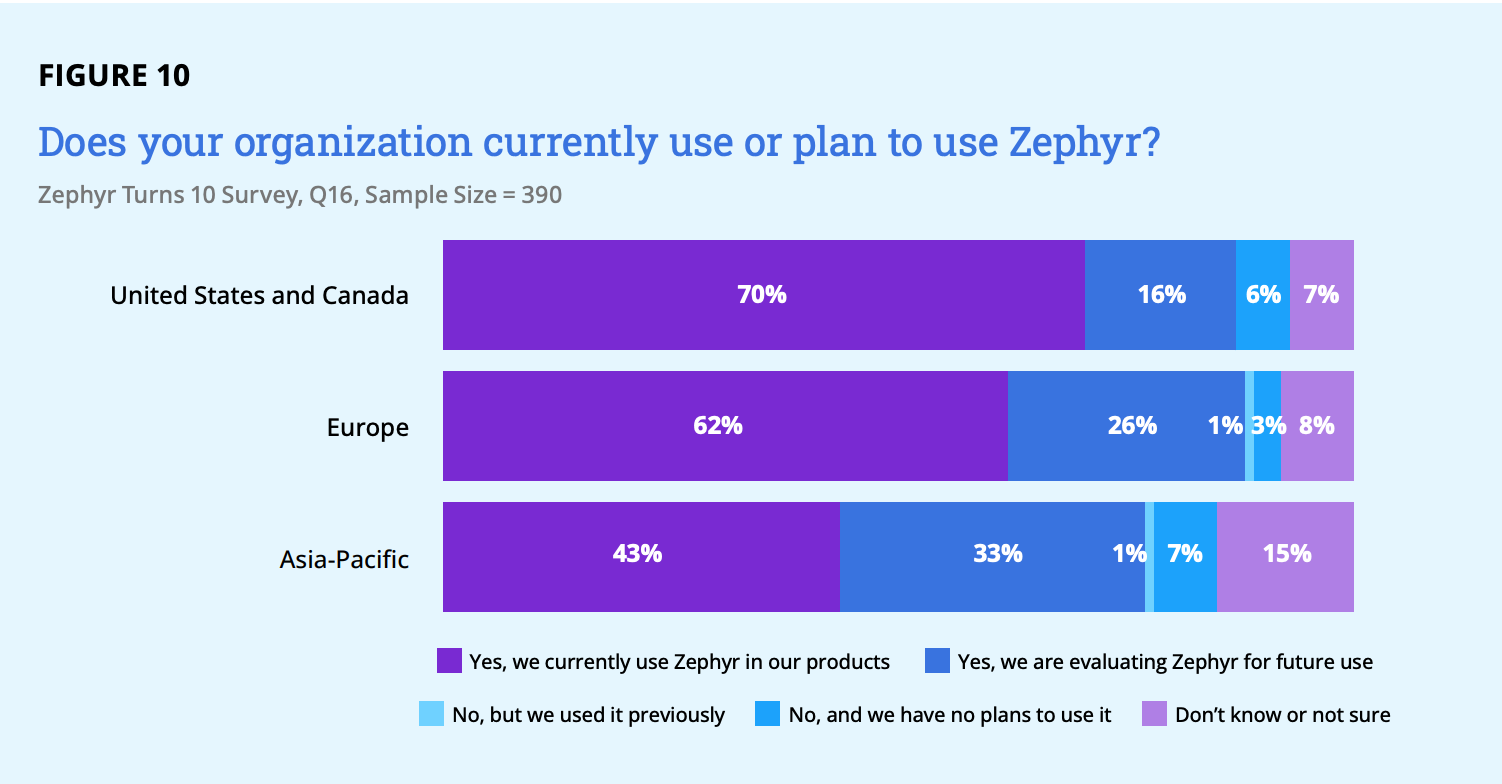
Ten years after launch, Zephyr shows a strategically significant adoption footprint across regions. Current usage is highest in the United States and Canada, where 70% of respondents report that their organization is already using Zephyr in products. Europe follows closely at 62%.
The report also shows strong evaluation pipelines outside North America. Europe and Asia-Pacific, including India, show the strongest evaluation activity, with 26% of European respondents and 33% of Asia-Pacific respondents actively evaluating Zephyr for future use.
Respondents from Mexico, Central America, the Caribbean, South America, and Africa also report growing interest, suggesting that Zephyr’s reach continues to expand.
Where Zephyr Is Today
Zephyr is widely regarded as important to organizational operations across surveyed regions.
In the United States and Canada, 59% of respondents rate Zephyr as extremely important or very important, with another 21% considering it important. In Europe, 47% rate Zephyr as extremely or very important, while 32% consider it important. In Asia-Pacific, 71% rate Zephyr as important, very important, or extremely important.
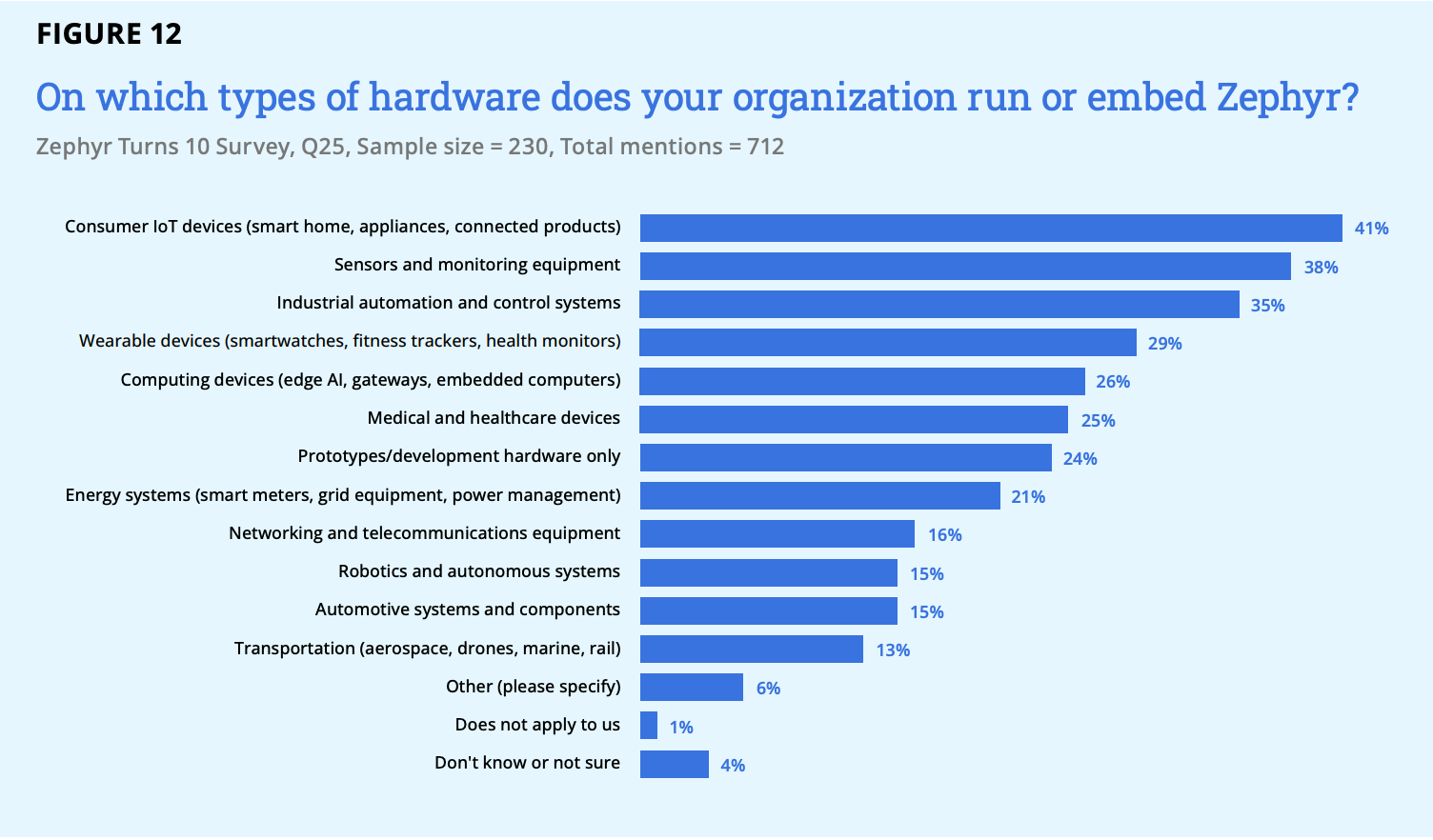
Zephyr is embedded across a wide range of hardware platforms and application contexts, including consumer IoT devices, sensors and monitoring equipment, industrial automation and control systems, wearables, computing devices, healthcare systems, custom ARM-based hardware, and general-purpose microcontrollers.
Regional differences further shape how Zephyr is used. In Europe, adoption is most strongly associated with sensors and monitoring equipment. In Asia-Pacific, adoption is most pronounced in consumer IoT devices. In the United States and Canada, organizations most commonly report embedding Zephyr in computing devices such as edge AI platforms, gateways, and embedded computing systems.
Zephyr’s Technical Footprint
Zephyr’s technical footprint reflects both continuity and evolution in embedded software development.
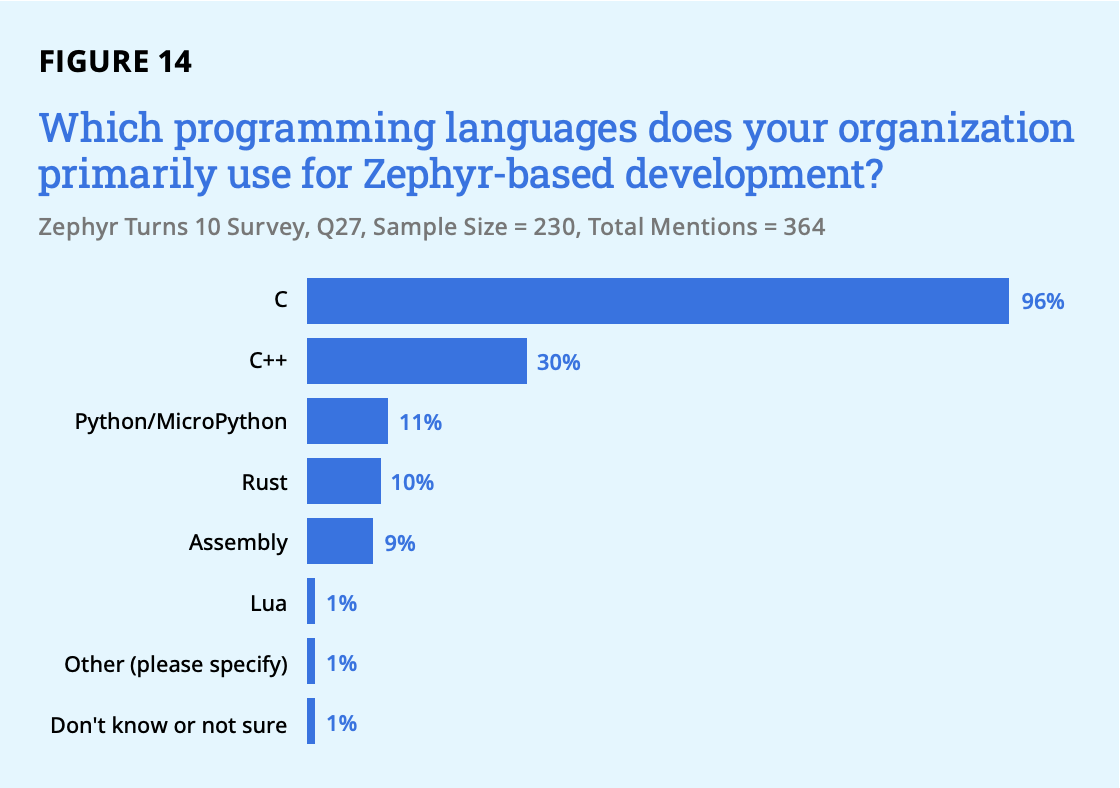
C remains the backbone of Zephyr-based development, with 96% of organizations reporting its use. C++ is also notable, with 30% of respondents using it in Zephyr-based application development. Zephyr also supports application languages beyond C, including Python/MicroPython, Rust, and Lua, which can help enable migration of existing applications on top of Zephyr.
On the hardware side, Zephyr remains firmly microcontroller-centric while demonstrating an expanding architectural reach. ARM Cortex-M platforms dominate Zephyr deployments, with 88% of respondents reporting usage.
At the same time, Zephyr’s support has broadened beyond its original MCU focus. 32% of respondents report using Zephyr on RISC-V platforms, with additional adoption on Xtensa-based systems at 21% and ARM Cortex-A processors at 17%.
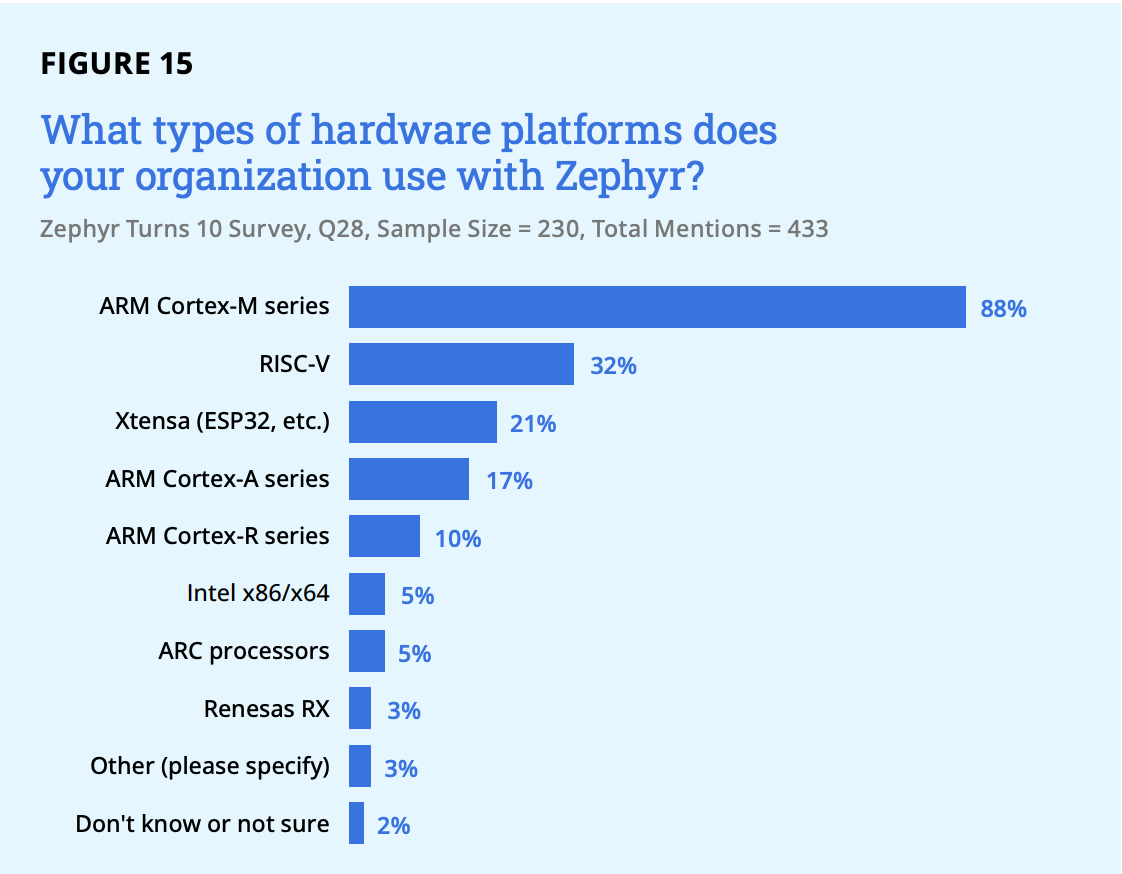
The report also shows a strong concentration on 32-bit architectures, with 91% of respondents reporting use on 32-bit platforms, while 20% indicate use on 64-bit systems.
What’s Next?
The report positions Zephyr as a stable and trusted platform. It also shows that long-term success depends as much on people, processes, and ecosystem health as on technical capabilities.
As Zephyr enters its next decade, respondents point to sustainability challenges including long-term maintenance, onboarding, security, and certifications. Emerging technologies, including Generative AI-based development tools, are viewed as promising productivity aids but are met with caution where correctness and verification remain crucial.
After ten years, Zephyr has become a widely deployed production infrastructure. Its next decade will be shaped by how well the project sustains that maturity while supporting constrained hardware, heterogeneous platforms, long product lifecycles, and the growing complexity of modern embedded development.
Read the full report here.