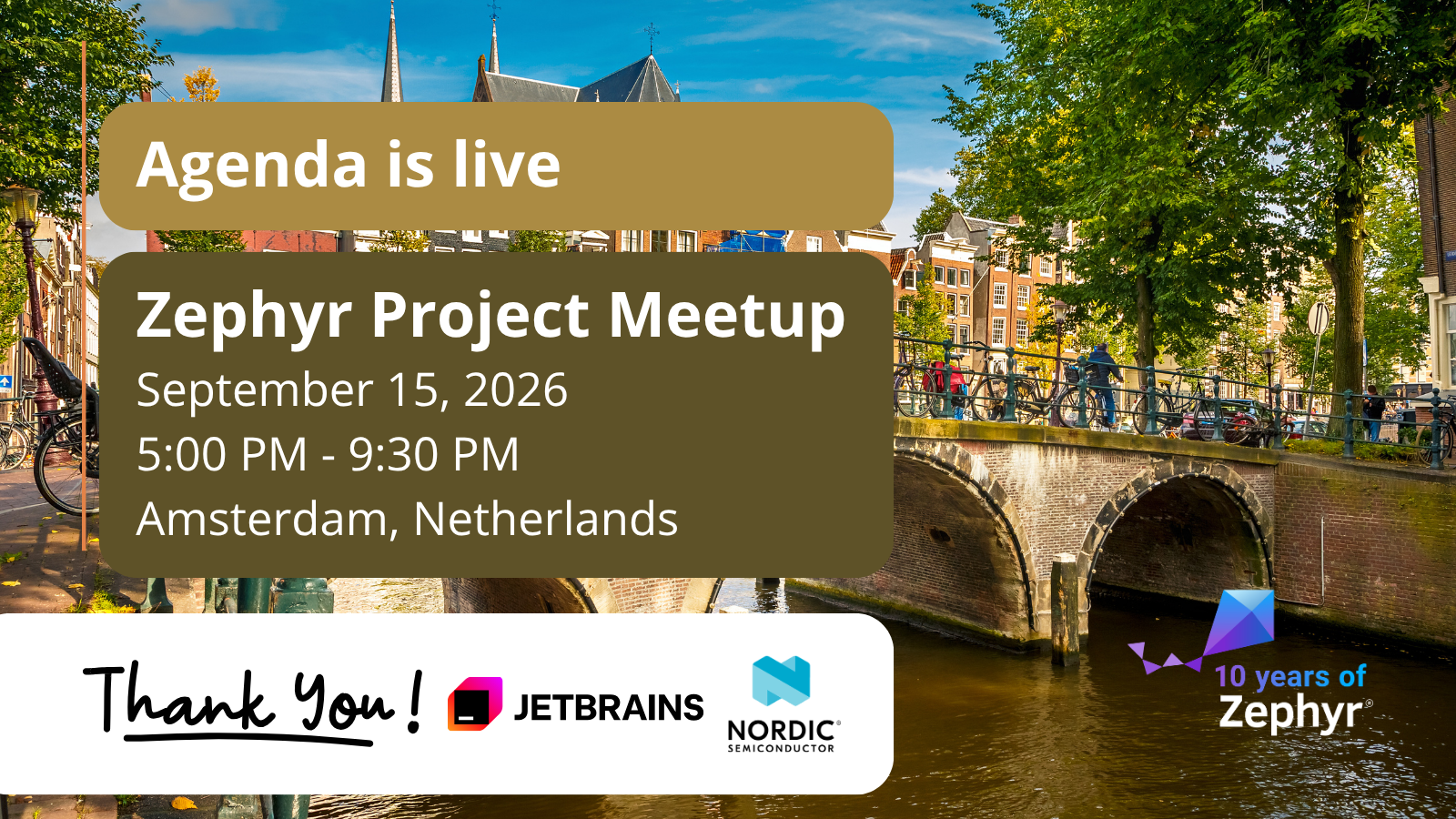
What are developers in the Netherlands building with Zephyr? On September 15, the embedded community will meet in Amsterdam to exchange practical knowledge, discuss current work, and learn more about the Zephyr RTOS.
The event is open to experienced contributors, first-time users, students, engineers, and anyone curious about open source embedded development.
Attendees can expect community-led presentations covering products built with Zephyr, subsystems, hardware support, developer tooling, implementation experiences, and lesser-known project features.
About the host team:
JetBrains is organizing the meetup and opening its Amsterdam office to the community. The company develops software tools for individuals and teams working across a wide range of programming languages and technologies.
Event details:
- Date: Tuesday, September 15, 2026
- Time: 5:00 pm–9:30 pm
- Venue: JetBrains office
- Address: Gelrestraat 16, 1079 MZ Amsterdam, Netherlands
Agenda:
5:00 pm – 5:30 pm: Welcome drinks and snacks
5:30 pm – 5:40 pm: Welcome and Opening Remarks by JetBrains team
5:40 pm – 6:10 pm: Welcome Note & How JetBrains Got Started with Zephyr – Artemy Pestretsov, Head of C/C++ Ecosystem, JetBrains
Join us for a warm welcome and a look at how JetBrains began its journey with Zephyr a few years ago. We’ll share the story behind the collaboration, the motivations, and the early steps that brought the two together.
6:15 pm – 6:30 pm: Fuzzing Zephyr with AFL and Renode – Zephyr Project – Eric Goodman, Manager RND Software, Vicentra
Fuzzing is one of the most effective ways to uncover memory corruption bugs and edge-case failures, but applying it to embedded systems is notoriously hard: real hardware is slow, hard to instrument, and difficult to scale. This talk shows how to fuzz Zephyr applications without any physical hardware by combining AFL with Renode, an open source instruction-level simulator. We’ll walk through setting up a fuzzing harness for a Zephyr target, feeding AFL-generated inputs into simulated peripherals, and catching crashes that would be nearly invisible on real boards. Attendees will leave with a practical, reproducible workflow for continuously fuzzing their own Zephyr firmware—particularly valuable for safety-critical devices where robustness isn’t optional.
6:30 pm – 7:00 pm: Break Time
7:00 pm – 7:30 pm: Making hardware less hard with Schematik – Mattia Fiumara, Founding Engineer, Schematik
Helping new developers from 0 to a working zephyr project is hard. Setting up the toolchain, understanding the zephyr syntax, devicetree.
Schematik makes setting up new zephyr projects easy by just using a prompt. In less than a couple of minutes a full-blown zephyr environment is set-up, compiled, flashed and running on your board, lowering the bar for getting into the zephyr ecosystem.
The presentation will showcase a short demonstration and explain the difficulties in getting AI to behave and give good results for starter projects.
7:35 pm–7:50 pm: What Our Zephyr Migration Proved, and What It Exposed About Embedded Education, Johan Korten, Researcher / Educator, HAN University of Applied Sciences
We started using Zephyr for our research project. Then we looked at our own curriculum and found something we did not expect.
At HAN University of Applied Sciences we moved a medical simulation research platform to Zephyr. The firmware of the modular measurement and validation controllers the research depends on, measuring: compression force, compression depth, respiratory resistance and compliance, tied together over CAN FD. Moved from what used to be bare-metal and FreeRTOS code against vendor SDKs to one application codebase targeting Renesas RA4E2, STM32 and Nordic nRF. In this talk we will focus on what moved, what did not, and what it cost, including sampling determinism where timing error becomes measurement uncertainty, and why Zephyr’s structure matters when firmware has to be part of a traceable evidence chain.
The second half is addressed to you as our customers. As every company here that hires embedded engineers receives graduates who have never seen Zephyr and pays for the onboarding; the project’s adoption gap is partly a supply problem. We expected that fixing this would mean cutting something, because curricula are full. Instead we read our own programme regulations and found learning outcomes are written in a way that it only mentions: integrate an existing RTOS, configure it for memory footprint, debug it. Zephyr satisfies every one.
One complication we are now facing as teachers is that AI assistance now carries students over the onboarding cliff, which is why we think that argument is finished. But it also breaks the link between “”it builds”” and “”the student understands””, and that graduate ends up in your code review. We propose craft before judgement, so we recommend to keep a small hand-written RTOS module, then use Zephyr as the substrate where students can configure, integrate and review, with assessment on the justification. Embedded engineering has what the wider AI-in-education debate lacks: a binding exists or it does not, the hardware answers.
We close with asks rather than conclusions, what a minimum viable educational onramp looks like; to the companies here, internships, graduation projects and lab hardware. And one question we cannot settle ourselves with: What should a graduate have learned by the time it gets a job?
Key takeaways
– A multi-vendor migration report from research instrumentation
– Why Zephyr can improve a curriculum and a check any lecturer can run this week on their own learning outcomes
– Why the onboarding cliff argument is finished, and why that is an employer’s problem as much as an educator’s relief
Audience: developers working on sensors, measurement and safety-relevant applications; anyone hiring embedded engineers or working on onboarding and training.
Together with Victor Hogeweij, former undergraduate student, knowledgable on / contributor to zephyr.
8:00 pm–8:15 pm: Quiz and Development Board Giveaways, closing remarks
8:20 pm onwards – Networking time
Register to Attend
Registration is required, and places are limited. Register for the event today!
Thank You to Our Supporters:
Thank you to JetBrains for hosting the meetup, providing the event space, and sponsoring the food and beverages.
A special thank you to Nordic Semiconductor for sponsoring the development board giveaways and supporting learning and community engagement at the event.
We also appreciate the speakers, volunteers, and attendees whose participation makes this event possible.
About the Zephyr Community Meetups
This meetup is part of the Zephyr Community Meetup Series, a collection of local gatherings hosted by community members with support from the Zephyr Project.
These events provide a welcoming space for developers, students, researchers, and embedded systems enthusiasts to exchange technical knowledge, present real-world projects, discuss challenges, and build stronger local open source communities.
Whether you are based in Amsterdam, or another part of the world, we encourage community members, companies, universities, and developer groups to get involved.
Reach out to us and explore how you can bring Zephyr to your community and make a difference in the world of IoT development.
To keep up to date about the project, subscribe to the Zephyr quarterly newsletter or connect with us on @ZephyrIoT, Zephyr Project LinkedIn or the Zephyr Discord Channel to talk with community and TSC members.
We look forward to seeing everyone in Amsterdam!