The Zephyr Project community is heading to Munich, Germany!
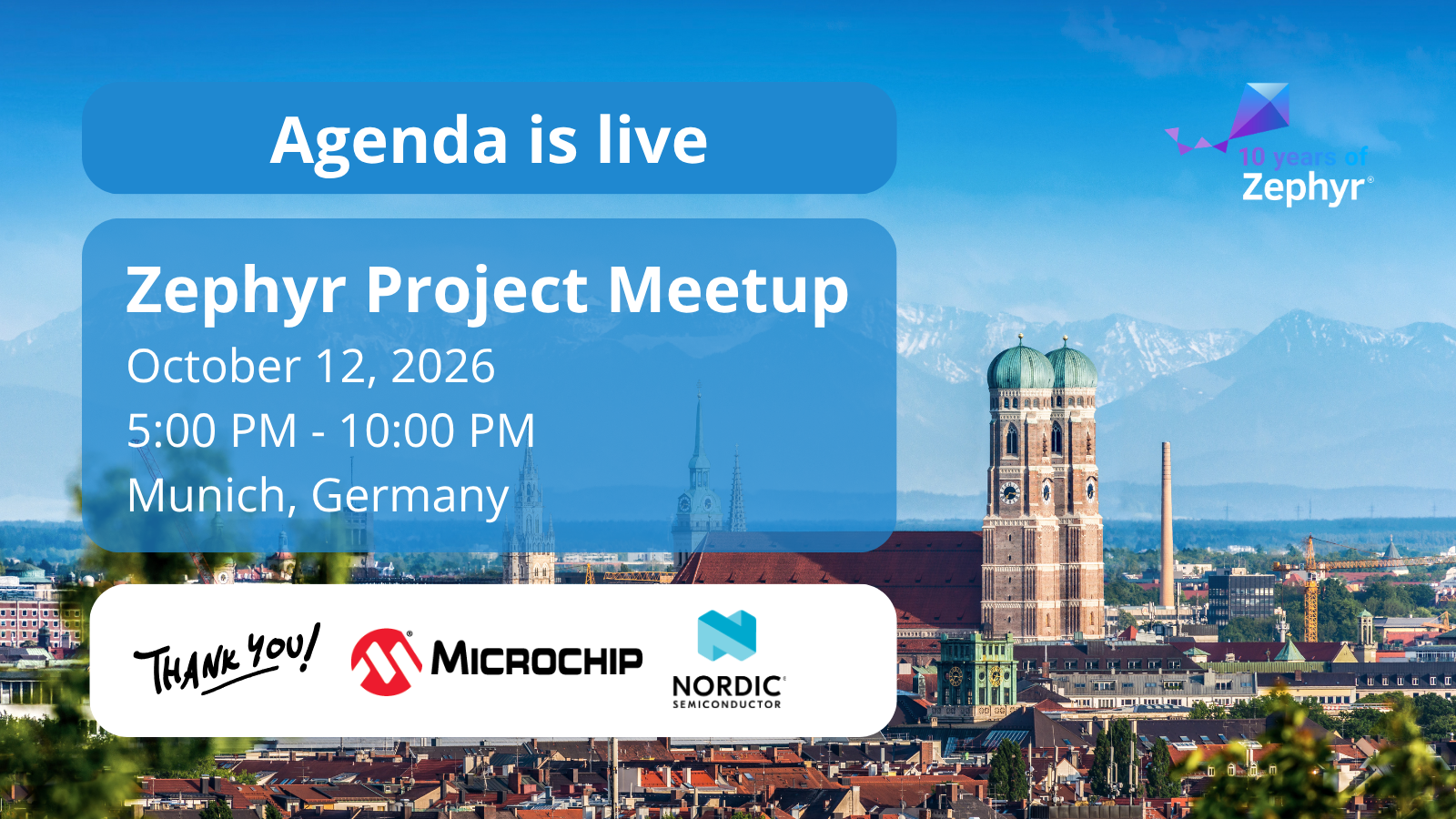
Join us on Monday, October 12, 2026, for an in-person Zephyr Project Meetup hosted by Microchip.
The event is open to developers, engineers, contributors, students, technology professionals, and anyone interested in open source, embedded systems programming, and software development. Whether you are an experienced Zephyr developer or are just beginning to explore embedded technologies, you are welcome to join.
About the Host: Microchip
Microchip is hosting the meetup alongside the European Microchip MASTERs 2026 Conference in Munich, giving attendees an opportunity to take part in both events.
Microchip MASTERs, the Microchip Annual Strategic Technical Exchange and Review, is an in-person learning event for engineers featuring technical courses, hands-on workshops, and expert-led sessions. The conference will also include Zephyr workshops and sessions.
What to Expect
The meetup will feature technical presentations about products running Zephyr, subsystems, practical development experiences, and features you may not have explored yet. Attendees will also have opportunities to ask questions, exchange ideas, and connect with members of the open source and embedded systems community.
Event Details
- Date: October 12, 2026
- Time: 5:00 pm – 10:30 pm
- Location: The Westin Grand Munich
- Address: Arabellastraße 6, 81925 München-Bogenhausen
- Map: Google Map
- Host: Microchip
- Food and Beverage Sponsor: Microchip
- Development Board Sponsors: Microchip and Nordic Semiconductor
Agenda
5:00 – 5:30 pm: Welcome drinks and snacks
5:30 – 6:00 pm: How I Made Sense of Device Tree Concepts – Sunil Abraham, Technical Staff, Microchip
Zephyr Device Trees are powerful, but understanding how hardware descriptions, bindings, and generated code work together can be challenging. In this session, I’ll share my journey of exploring some of the most commonly used—and often confusing—Device Tree concepts, using practical examples and real-world driver development experience.
We’ll cover node labels and variations, Device Tree navigation, #address-cells and #size-cells, cells and phandles, Kconfig integration, ranges and address translation, dt_spec, overlays and snippets, and pinctrl states.
6:05 – 6:20 pm: Adding dynamic frequency scaling, voltage scaling and power saving to the stm32n6 – Tobias Meyer, Iot Device Expert, Hula Earth Technology
How you can use Hardware in the loop, an agent and the goal in mind and available HALS,LL and zephyr api to add support for power saving functionalities. Struggles, making it run and what is left.
6:20 – 6:35 pm: Break
6:35 – 7:05 pm: Building Trusted Zephyr® Systems with ATECC608 and CryptoAuthLib – Anton Brauchle, Senior Technical Staff Engineer, Microchip
This presentation provides an overview of integrating the ATECC608 secure element and CryptoAuthLib into Zephyr®-based applications to support practical embedded security use cases. It begins with foundational library integration, then progresses to secure boot implementation, and concludes with TLS authentication. The objective is to equip engineers with the knowledge needed to develop trusted Zephyr systems that leverage hardware-backed keys for authentication, boot validation, and secure communications.
7:10 – 7:25 pm Industrial Control with Zephyr RTOS: From Bare Metal to Mainline on the SmartFusion2 SoC-FPGA – Andreas Kofler, CEO, bavariamatic GmbH
Hybrid SoC-FPGAs like Microchip’s SmartFusion2 combine a hard ARM Cortex-M3 core with configurable FPGA fabric — a compelling platform for industrial control, but one with no Zephyr support until recently.
This talk documents how we brought the SmartFusion2 M2S010 to Zephyr mainline: a full SoC port with board support for two hardware targets — the M2S010 MKR Kit and the M2S Hello FPGA Kit.
The central insight was that SmartFusion2’s MSS peripheral IPs are shared with Microchip’s PolarFire SoC family. Rather than writing redundant drivers, we reused existing Zephyr drivers for UART, SPI, and I2C through careful devicetree compatible-string mapping. The only driver written from scratch was a new clock controller, since SmartFusion2’s clock architecture has no PolarFire equivalent. We will also cover a subtle but important constraint: clock topology is fixed in the FPGA hardware design — Zephyr operates on a pre-configured clock tree.
Beyond the technical implementation, we will walk through the upstream review process candidly — what maintainers required, where restructuring was needed, and what the iterations actually looked like.
7:25 – 7:40 pm: Refreshment break
7:40 – 7:50 pm: Where Zephyr Fits in Space Computer Architecture – Yasushi Shoji, Space Cubics Inc.
Using Zephyr in space is not only a question of choosing an RTOS. A space computer is a system architecture: boot firmware, supervisor logic, watchdogs, safe mode, recovery paths, update policy, hardware monitoring, FPGA or SoC configuration, and the boundary between platform software and mission-specific applications all matter.
This talk looks at Zephyr from that system-architecture point of view. Based on Space Cubics’ OBC development experience and recent Space Grade Linux discussions, it explores where Zephyr can fit in future space systems: mission RTOS, payload-controller OS, supervisor/control-plane OS, or companion to Linux. Space already has credible RTOS options, but Zephyr can bring value if the ecosystem develops a clear architectural story around boot, recovery, observability, hardware control, and responsibility boundaries.
Attendees will leave with a practical checklist for evaluating Zephyr’s role in a space computer: what Zephyr should control, what should remain outside it, what must be recoverable after launch, and how to structure boot, update, monitoring, isolation, and fault-handling responsibilities.
7:55 – 8:05 pm: Extreme Macro Photography with Zephyr – Maximilian Huber, Principal Consultant, TNG Technology Consulting
With https://github.com/maxhbr/zephyr-rail I built a hobby project that demonstrates several features of Zephyr like:
* State Machine Framework
* zbus
* Zephyr Shell
* native_sim
* drivers and the device tree
* connection to my DSLR via bluetooth
* a single page web application that controls the device via Chrome’s bluetooth features
* …This broad sweep gives a nice overview from a hacking perspective.
8:10 – 8:25 pm: Don’t Fly Blind: Monitoring Zephyr Devices in Production – David Nepožitek, Software Engineer, Spotflow
Writing firmware is only the beginning. Once devices are deployed at scale, the another challenge begins. Are the devices behaving as expected? Are users running into errors? Is someone probing for vulnerabilities? Without the right monitoring in place, these questions go unanswered, and problems appear only when it’s too late. To understand what is really happening in the field, we need to take deliberate steps to instrument our devices and collect meaningful data about their inner workings.
This talk covers what it takes to monitor Zephyr devices in the field:
– Why monitoring matters: the questions you’ll face in production, and how monitoring answers them.
– Monitoring with Zephyr: making the most of built-in subsystems like logging and core dumps, and what to add when they’re not enough.
– Monitoring under constraints: what data is worth collecting and what trade-offs can be made.
8:25 – 8:40 pm: Break
8:40 – 8:55 pm: Using Zephyr: Expectations and Responsibilities – Loic Domaigne, Senior Technical Staff Member, Doulos GmbH
Key industry players in the medical, energy, automotive, aerospace sectors, to name a few, are seriously looking to use Zephyr®. What’s interesting: we see that Zephyr® is now entering departments that are used to traditional “proprietary software/business” setting. Switching to Zephyr raises many questions, like:
– When will feature X be integrated?
– Is there any Service Level Agreement for fixing bugs?
– How is testing done?
– Etc.
In this presentation, we will clarify what you can expect from the Zephyr® project, what is your responsibilities as a product developer/manufacturer and how Zephyr® helps you in that regards. Keywords: Project Pulse, PR, Testing, Code Review, Weekly Full Twister Run, CI, Release Management, Hardware Testing, being in the driver seat.
8:55 -10:00 pm: Closing remarks and networking
Registration
Registration is required to help the hosts plan the space and event logistics. Seats are limited, so register soon to secure your place. Register for the meetup here.
Thank You to Our Supporters
Thank you to Microchip for hosting the meetup and sponsoring food, beverages, and development board giveaways. We also thank Nordic Semiconductor for sponsoring additional development board giveaways.
We appreciate the speakers, volunteers, and attendees whose participation makes this event possible.
Support an Upcoming Zephyr Meetup
Interested in sponsoring development board giveaways or food and beverages for an upcoming Zephyr meetup? Complete the sponsorship interest form, and our organizers will contact you with event details and coordination information.
About the Zephyr Community Meetups
This meetup is part of the Zephyr Community Meetup Series, a collection of local gatherings hosted by community members with support from the Zephyr Project.
These events provide a welcoming space for developers, students, researchers, and embedded systems enthusiasts to exchange technical knowledge, present real-world projects, discuss challenges, and build stronger local open source communities.
Whether you are based in Munich, Germany, or another part of the world, we encourage community members, companies, universities, and developer groups to get involved.
Reach out to us and explore how you can bring Zephyr to your community and make a difference in the world of IoT development.
To keep up to date about the project, subscribe to the Zephyr quarterly newsletter or connect with us on @ZephyrIoT, Zephyr Project LinkedIn or the Zephyr Discord Channel to talk with community and TSC members.
We look forward to seeing everyone in Munich, Germany!