
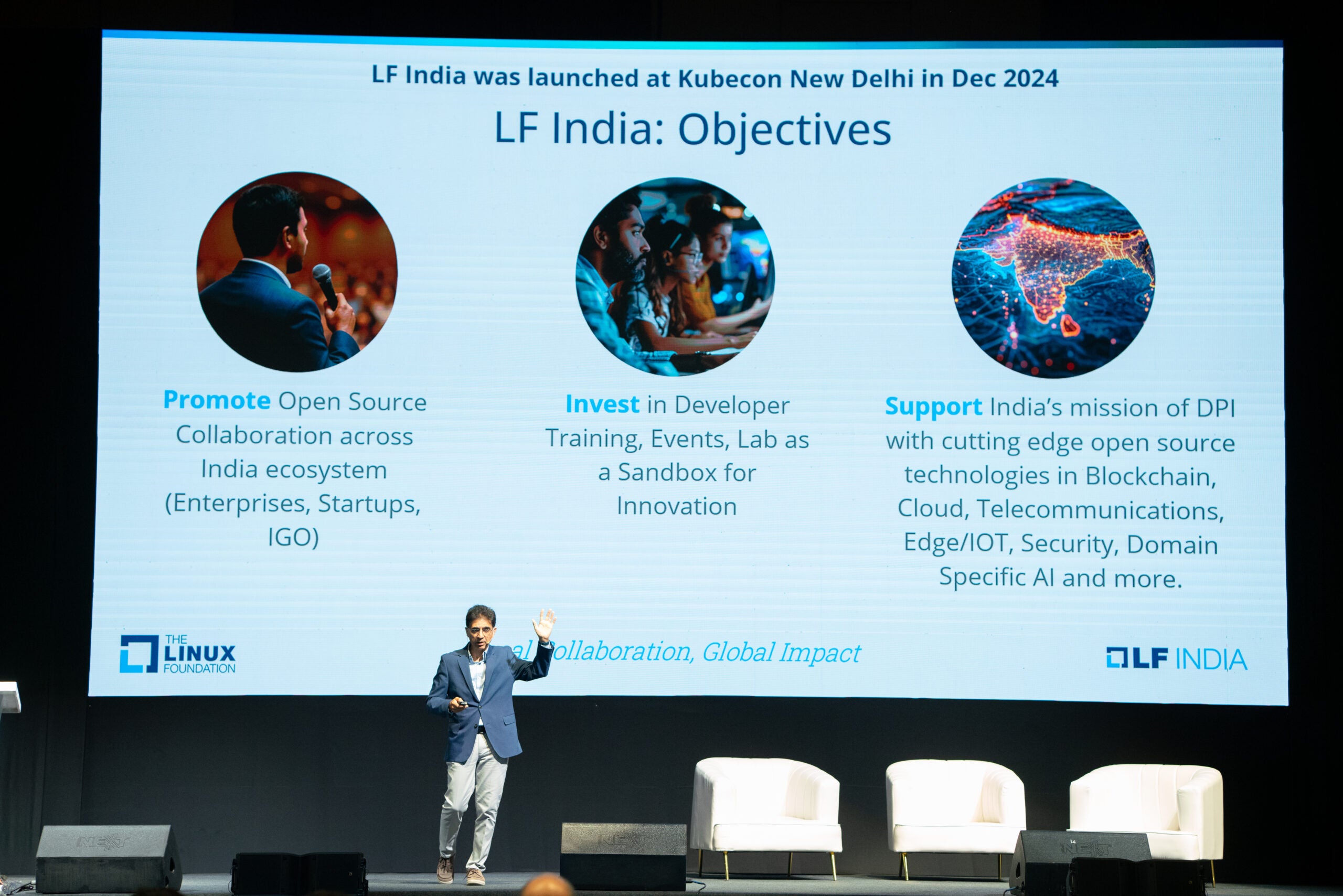
The Open Source Summit India took place on August 5, 2025, in Hyderabad, bringing together a vibrant mix of open source developers, technologists, and community leaders. With 984 in-person attendees representing 323 leading organizations, the event highlighted the growing strength of India’s open source ecosystem and its global connections.
The audience was diverse and highly technical, with 65% of participants in engineering or technical roles. The most represented countries were India, USA, and the UK, reflecting both regional leadership and international collaboration.
The event featured:
-
A wide range of cross-domain open source sessions—from Linux kernel and cloud infrastructure to AI/ML, embedded, and security
-
Dedicated tracks on community leadership, OSPO strategies, and policy discussions shaping the future of open source
-
A Zephyr track tailored for developers building or considering embedded products with Zephyr RTOS, covering security, long-term support, tooling, and real-world applications across industries
The Zephyr Project had a notable presence at the summit with three dedicated talks highlighting Zephyr’s growing role in embedded, IoT, and heterogeneous system development:
- Zephyr for Open Source Health Devices – Ashwin Whitchurch, ProtoCentral Electronics
- Zephyr Support for Heterogeneous SoCs – Amneesh Singh & Soumya Tripathy, Texas Instruments
- Introduction to Twister and Adding Support for Hardware Runners – Kedareswara Rao Appana, AMD
These sessions explored how Zephyr enables innovation in medical IoT, supports complex multi-core SoC architectures, and simplifies large-scale embedded testing through Twister and hardware runners.
Zephyr for Open Source Health Devices – Ashwin Whitchurch, ProtoCentral Electronics
In this session, Ashwin Whitchurch from ProtoCentral Electronics shared how the Zephyr RTOS has been pivotal in building a new generation of open source health monitoring devices. Drawing from projects like HealthyPi 5, HealthyPi 6, and the wearable HealthyPi Move, Ashwin demonstrated how Zephyr enabled the development of a single unified firmware codebase that seamlessly runs across multiple microcontroller platforms and hardware form factors.
The talk explored the journey from using proprietary SDKs to adopting Zephyr, highlighting its modular architecture, hardware abstraction, and strong upstream community support. Ashwin discussed key Zephyr features leveraged in their products, including state machine frameworks, Zbus messaging, real-time I/O (RTIO) for high-speed sensor data, LittleFS for reliable flash storage, and built-in OTA firmware update mechanisms.
He also covered the challenges of developing low-power, wearable medical devices, transitioning between platforms amid chip shortages, and managing multi-core SoCs efficiently. The session concluded by emphasizing how Zephyr accelerates scalability, simplifies prototyping, and empowers developers to create auditable, secure, and truly open source medical systems enabling healthcare innovation without vendor lock-in. Slides here.
Zephyr Support for Heterogeneous SoCs – Amneesh Singh & Soumya Tripathy, Texas Instruments
In this session, Amneesh Singh and Soumya Tripathy from Texas Instruments shared their experience enabling the Zephyr RTOS on the AM243x Evaluation Module, a heterogeneous SoC featuring both Cortex-R5 and Cortex-M4 cores. The talk offered a step-by-step walkthrough of bringing up Zephyr on such complex multiprocessor systems—covering SoC target definitions, board configurations, device trees, and initialization hooks.
The speakers explained how to implement and extend Zephyr’s device driver model, demonstrating the process of writing vendor-specific drivers and leveraging subsystems like I²C, SPI, and CAN. They also highlighted challenges unique to heterogeneous platforms, such as resource sharing, peripheral pin-muxing, memory protection unit (MPU) setup, and inter-core communication (IPC).
A significant focus was placed on system requirements—including clock and power management—and the limitations encountered with MCUboot as a bootloader in multi-core environments. The session examined alternative approaches, including TI’s own RTOS bootloader, and discussed potential paths toward better multi-core boot support in Zephyr.
The session concluded with lessons learned, current gaps, and guidance that can serve as a reference blueprint for enabling Zephyr on future heterogeneous SoCs, balancing upstream alignment with vendor-specific requirements. Slides here.
Introduction To Twister and Adding Support for Hardware Runners – Kedareswara Rao Appana, AMD
In this session, Kedareswara Rao Appana from AMD provided a deep dive into Twister, Zephyr RTOS’s automated testing framework, and demonstrated how to extend its capabilities by integrating custom hardware runners. Twister plays a critical role in Zephyr’s testing ecosystem by automating the entire pipeline: discovering test cases, building for multiple targets, executing tests on hardware or emulators, and aggregating results into machine-readable formats like XML, JSON, and HTML for CI/CD workflows.
The session began with an overview of Twister’s architecture, breaking it down into its key stages:
- Test Discovery – scanning the repository to identify YAML-based configurations and test metadata
- Filtering & Selection – selecting applicable tests based on platform, features, and tags
- Configuration & Build – leveraging CMake and Ninja to prepare Zephyr-based test executables
- Execution & Logging – deploying tests on real hardware or emulators and collecting runtime outputs
- Result Aggregation & Reporting – categorizing pass/fail status, measuring performance metrics, and generating structured reports
A major focus was on adding custom hardware runner support, demonstrated using the XSDB (Xilinx System Debugger) runner, a critical tool for programming and debugging Versal and Versal Gen2 SoCs. Kedareswara explained how runners act as bridges between Zephyr’s build system and target boards, enabling test automation on vendor-specific hardware. The process involved creating Python runner classes, registering them in Twister, and integrating them via CMake to ensure seamless deployment across multiple platforms.
The session concluded with practical insights on debugging, optimizing flashing workflows, handling multi-board setups, and extending Twister for custom testing environments. By combining Twister’s flexible testing infrastructure with hardware runners, developers can automate large-scale testing across heterogeneous SoCs, reduce turnaround times, and improve reliability in Zephyr-based embedded systems. Slides here.
About the Community
To keep up to date about the project, subscribe to the Zephyr quarterly newsletter or connect with us on @ZephyrIoT, Zephyr Project LinkedIn or the Zephyr Discord Channel to talk with community and TSC members.