Written by Hilary Carter, Senior Vice President of Linux Foundation Research
The beauty of open source collaboration is that, unlike commercial aviation, it never relies on a single flight path or a single carrier to reach its destination. Mumbai was my destination this week for Open Source Summit India. However, what began with a significant and highly disruptive administrative failure regarding permissions to land in Mumbai for one of the airlines responsible for my travel, set off a chain reaction of cancellations, increasing costs, and backlog, and so, regrettably my journey to Mumbai did not come to pass. The code, however, moves forward, and today I remotely bring the core insights of “Zephyr at 10: The Open RTOS for India’s IoT” directly to you.
The crucial role of community feedback
To truly understand an open source project’s trajectory, project stakeholders cannot rely on guesswork. Empirical research serves as a critical diagnostic tool to measure market adoption, collect direct feedback from developers, and establish objective baselines for future strategy.
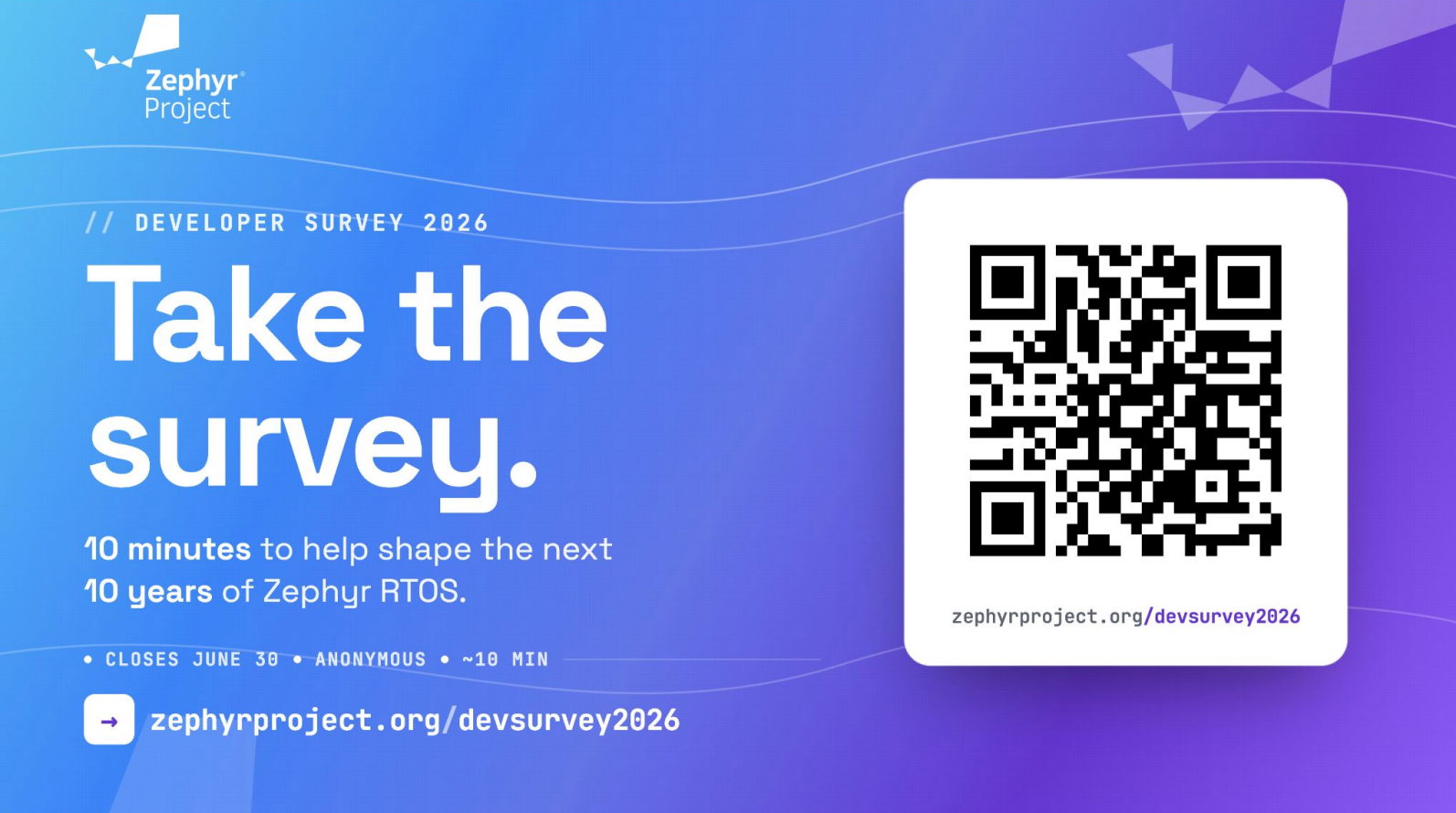
We recently saw the power of this structured approach with the release of the comprehensive report, “Zephyr Turns 10: A Decade of Adoption, Maturity, and Ecosystem Evolution.” To continue capturing the pulse of the ecosystem, the project has officially launched the 2026 Zephyr Developer Survey. This short, anonymous questionnaire will directly shape the next ten years of strategy and technical priorities for project leadership.
Shape the Next Decade: The 2026 Developer Survey is open until June 30. If you are building on or contributing to Zephyr, take 10 minutes to make your voice heard.
What research reveals about Zephyr today
A decade of deliberate development and adherence to security-by-design principles has completely reshaped the real-time operating system (RTOS) landscape. Data extracted directly from GitHub highlights an incredibly fast-moving community. Zephyr currently clocks an astonishing 3.5 commits per hour, powered by a monthly active contributor base of 436 developers pushing over 2,500 commits every single month.
When compared to other prominent RTOS choices in the open source landscape, the results of applying these community best practices are clear:
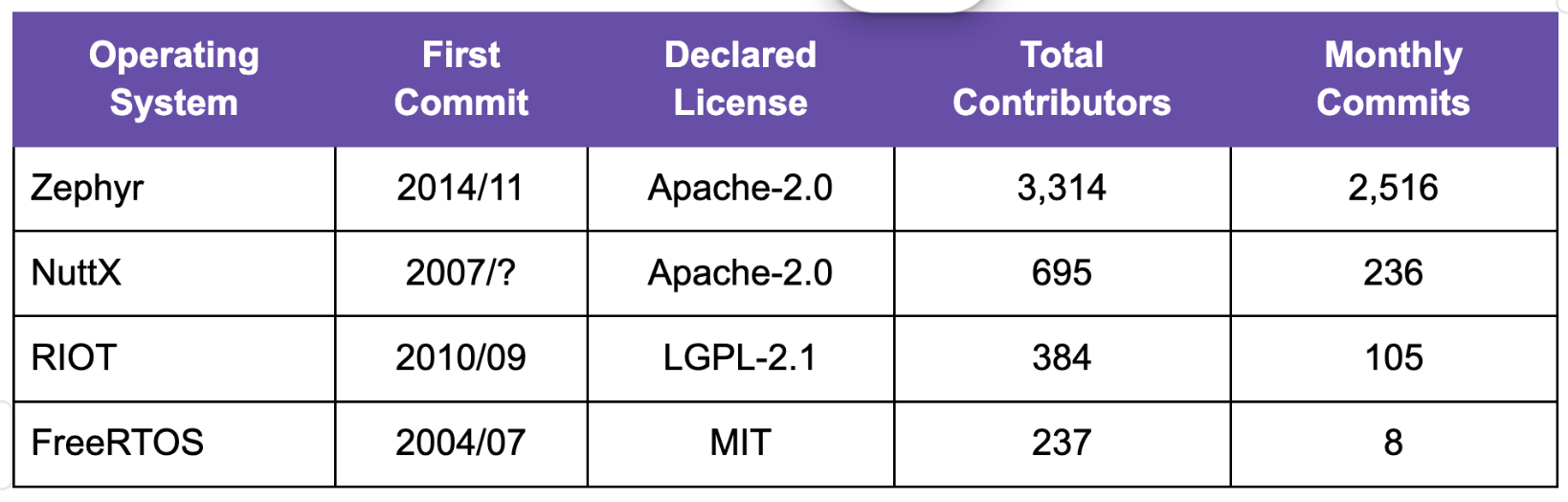
This massive contributors-to-commits ratio emphasizes Zephyr’s evolution into a robust, scalable platform that uniquely bridges the gap between highly constrained footprints (<8KB Flash and <5KB RAM) and massive, complex multi-core systems.
Versatility in the field and market trajectory
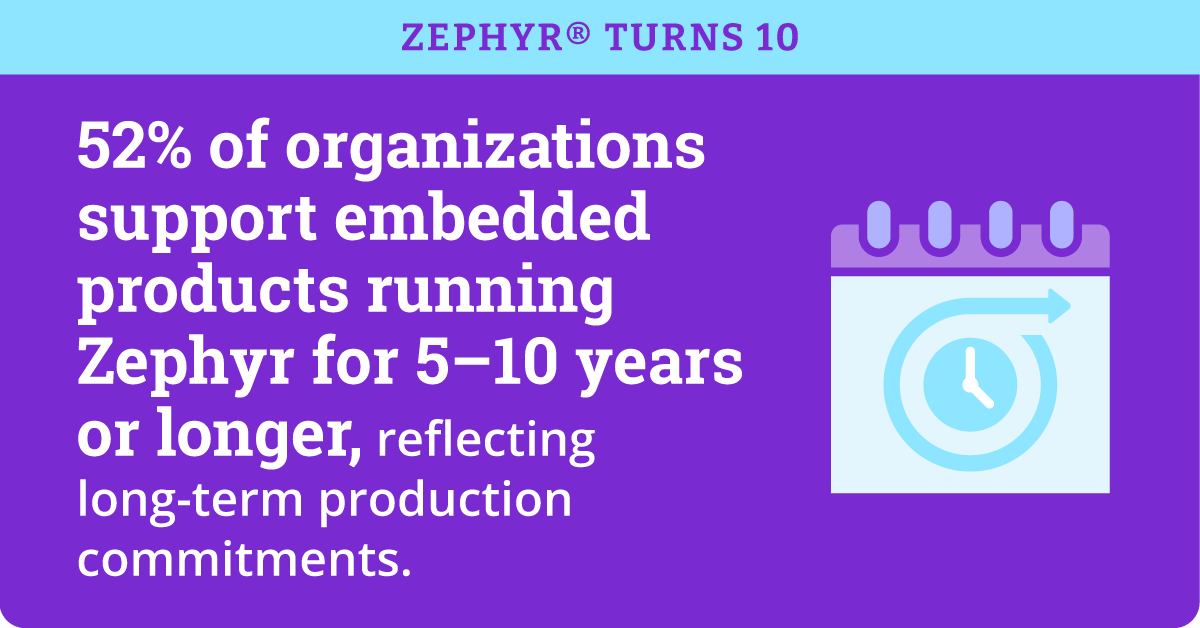
Today, subject matter experts confirm that Zephyr has reached complete production-ready maturity, sporting exceptionally stable stacks suited for long-lifecycle industrial environments designed to run unsupervised for decades. As revealed in the report, this stability matches market realities: 26% of organizations support embedded lifecycles of 5 to 10 years, and an additional 17% manage products lasting between 10 and 15 years.
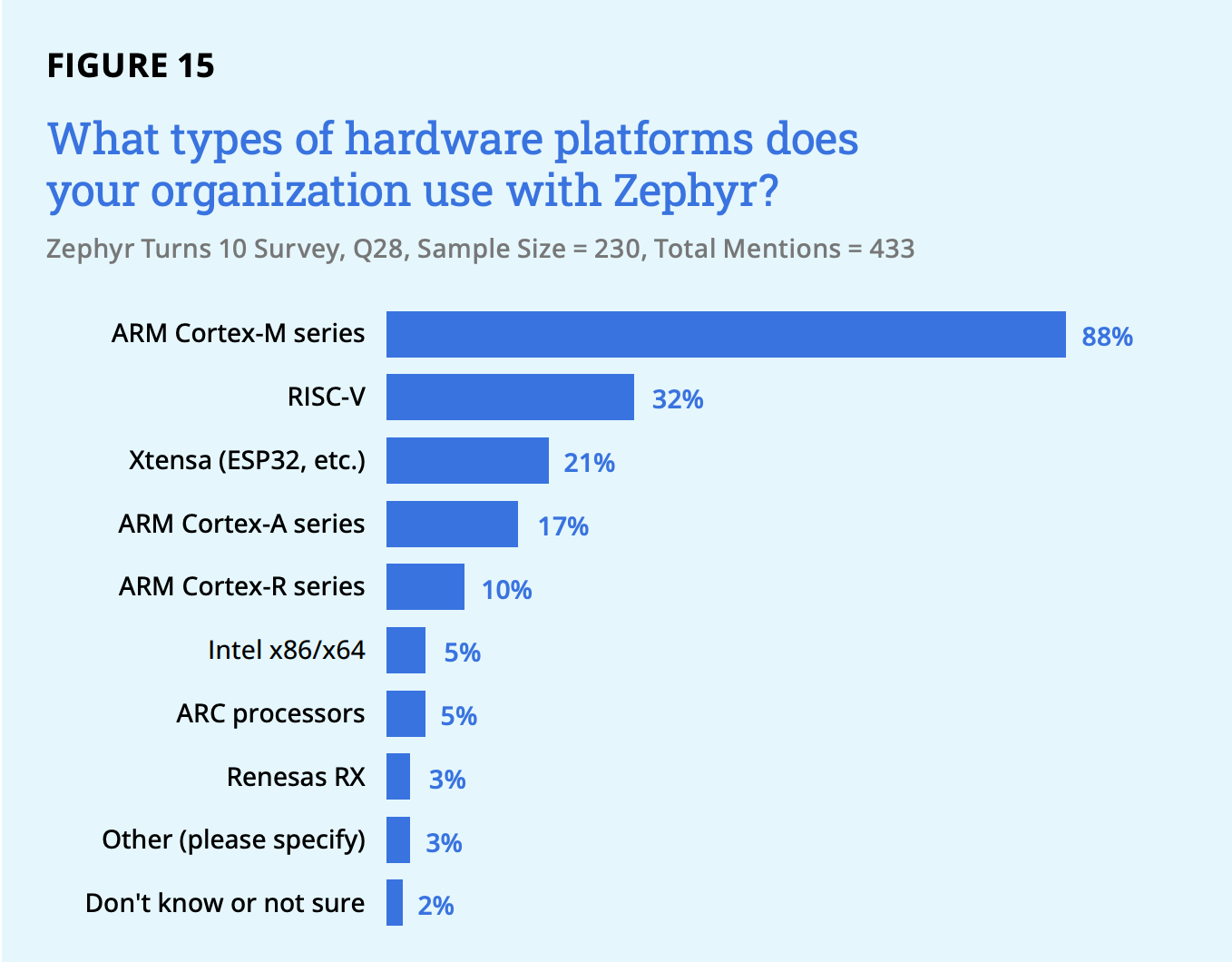
Because of this stability, Zephyr’s ecosystem has expanded across a highly diverse set of market segments. While its largest footprint is anchored in industrial automation (45%) and consumer IoT (44%), that footoprint is rapidly expanding into automotive systems, healthcare devices, smart energy grids, and wearables, too!
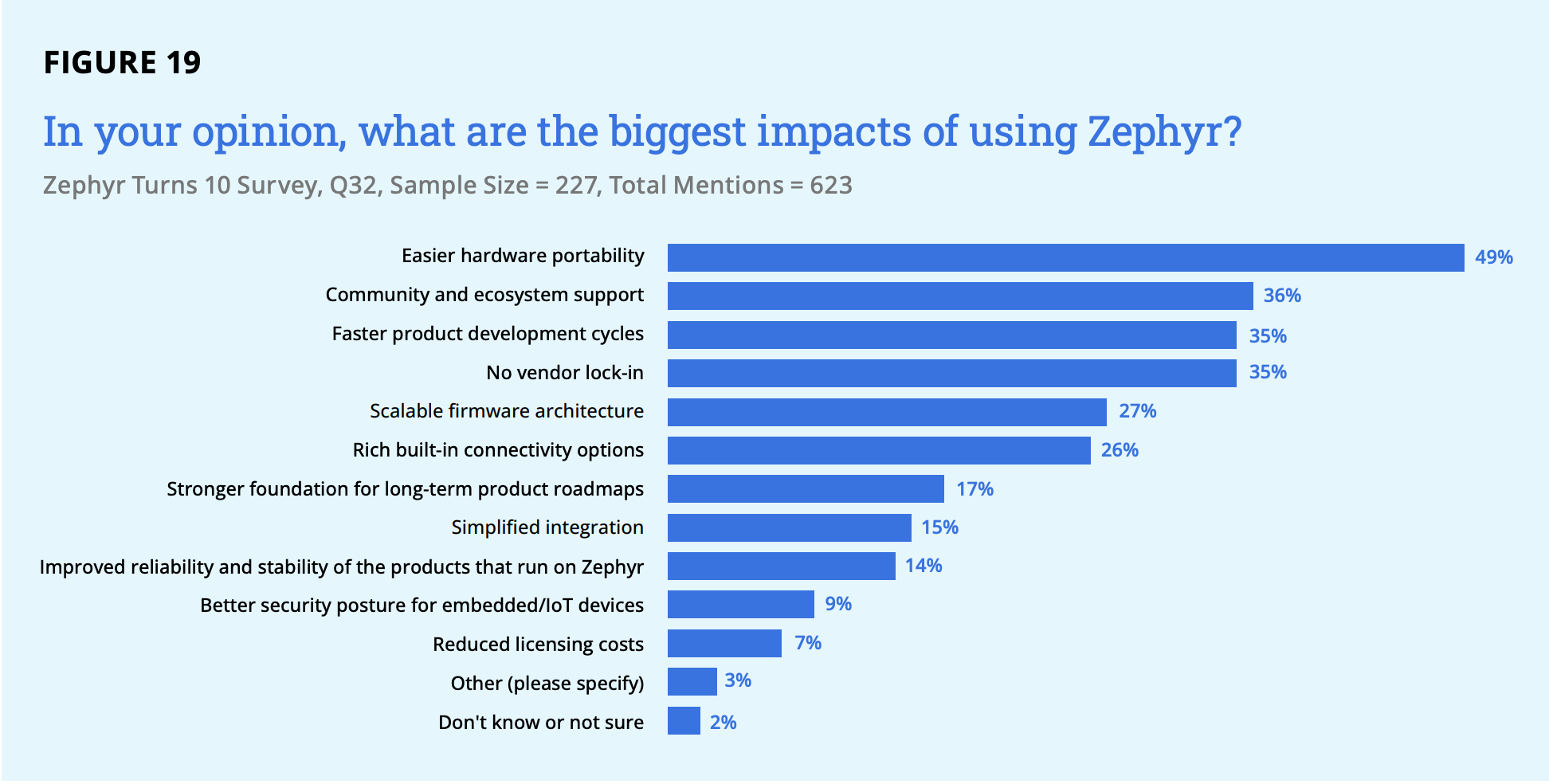
Furthermore, the code is highly portable, offering native out-of-the-box support for over 1,000 boards and 300 integrated sensors. This cross-vendor flexibility is why Figure 19 shows that 49% of organizations cite easier hardware portability as the primary impact of adopting the operating system—allowing teams to bypass boilerplate code, swap chipsets seamlessly, and sidestep vendor lock-in entirely.
The horizon: Mapping the next 10 years
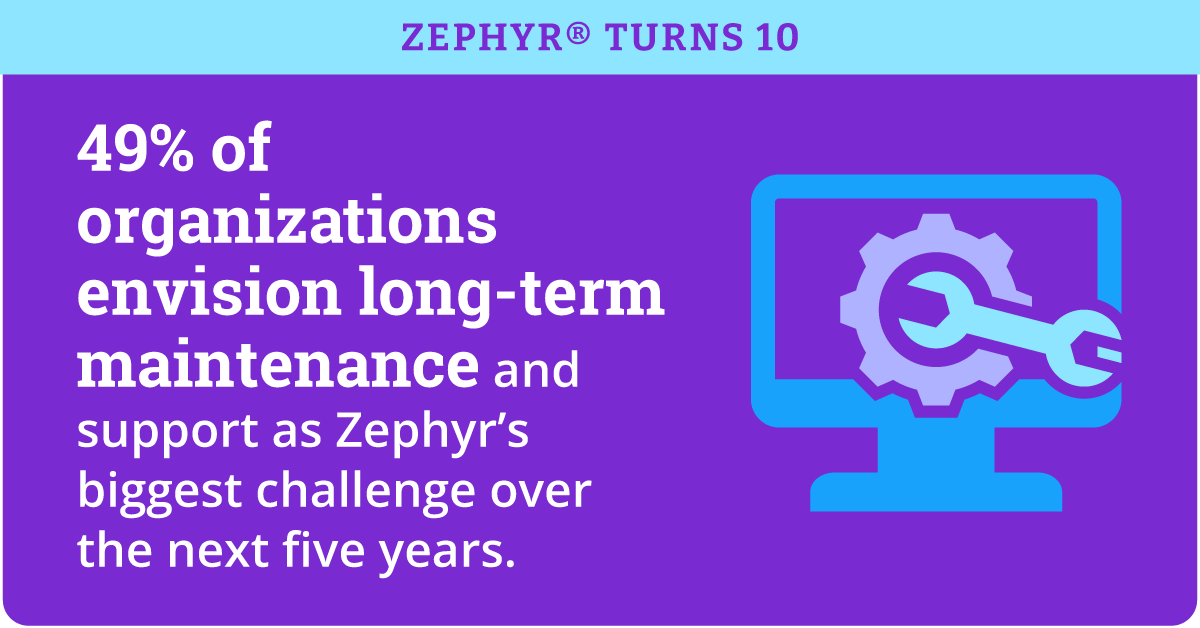
As Zephyr enters its second decade, the priorities of the developer community are shifting from pure feature acquisition to long-term sustainability. As shown in Figure 23 (Challenges on the Horizon), 49% of organizations pointed to maintenance and long-term support as their main challenge over the next five years, followed closely by a demand for safety certifications (40%).
When looking forward across the next decade, developers have articulated a clear wish list:
- A richer ecosystem of libraries, middleware, and integrations (42%)
- Stronger long-term maintenance and predictable LTS guarantees (40%)
- Simplified onboarding workflows, formal training modules, and documentation for teams (39%)
Get involved!
Though airport delays kept us apart in person, the true strength of open source is that its center of gravity isn’t a physical conference hall—it’s the global, distributed community. Thank you to the thousands of developers who have committed code, filed issues, and built incredible products on Zephyr over the past ten years. Let’s build the next decade together.
- Contribute Code: github.com/zephyrproject-rtos
- Join the Conversation: chat.zephyrproject.org
- Share Your Feedback: Take the 2026 Developer Survey before June 30.
PDF