The Zephyr Project community is heading to Vienna, Austria!
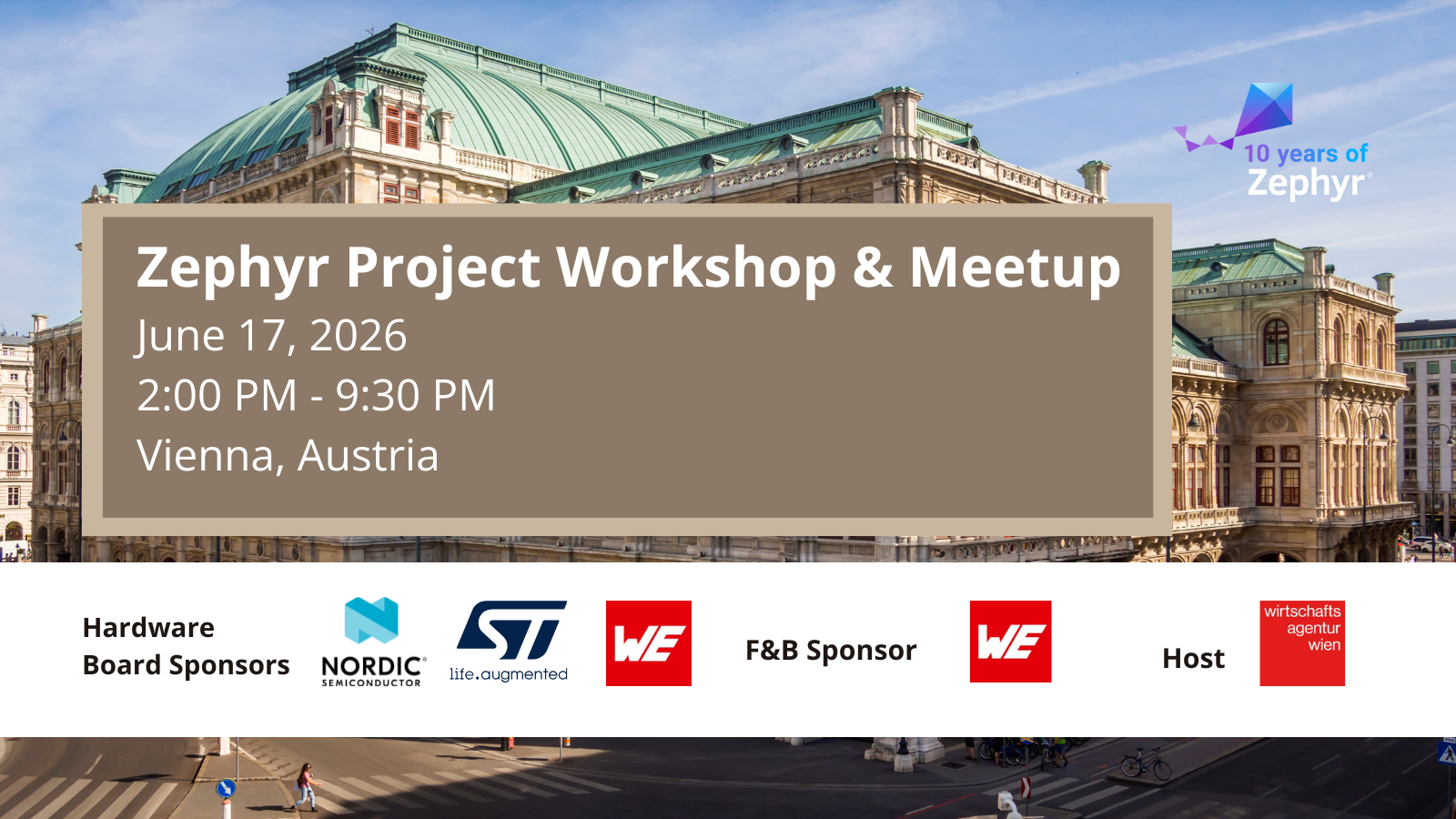
Join us on Wednesday, June 17, 2026, for an in-person Zephyr Project Workshop & Meetup hosted by local developers from Vienna. The event will take place at the Expat Center of the Vienna Business Agency, located at Schmerlingplatz 3, 1010 Vienna, Austria.
This gathering is open to anyone interested in open source, embedded systems programming, software development, dependable systems, and low-power connected devices. Whether you are an experienced Zephyr contributor, an embedded systems professional, or just beginning to explore real-time operating systems, this event is a great opportunity to learn, connect, and exchange ideas with the community.
The primary language for group communication and event sessions will be English, and we warmly welcome individuals from all backgrounds.
What to Expect
The Vienna event will include a hands-on introductory workshop followed by an evening meetup featuring technical talks, community conversations, and networking opportunities.
Event Schedule
2:00 PM – 5:00 PM | Workshop
Workshop leads: Christian Hirsch (Hardware & Software Developer, Hirsch.Zone), Jonas Remmert (Firmware Engineer, SMIGHT GmbH)
This workshop introduces Zephyr through practical examples and hands-on exercises. We will cover the core ideas needed to become productive with Zephyr, including the workspace structure, building and running samples, and how Zephyr approaches hardware abstraction. Along the way, we will look at essential subsystems that make embedded development easier, such as the shell, logging, and other ready-to-use building blocks.
In addition, the workshop includes a hands-on session on real hardware. A BLE sample will be demonstrated with an actual Nordic nRF54L15 DK evaluation board, and every participant will receive a Nordic evaluation board.
At the end of the workshop you will understand how to start your project with Zephyr, utilize essential subsystems and interact with Hardware and BLE.
Requirements for the workshop:
- A notebook with the Zephyr development environment already set up.
- Please prepare your system before the workshop by following the Zephyr Getting Started Guide. Make sure you can build a Hello World sample for the Nordic board target `nrf54l15dk/nrf54l15/cpuapp`, and that you can build and run it with the simulation target `qemu_cortex_m3`.
Zephyr Project Meetup :
5:30 PM – 9:30 PM | Meetup
The evening meetup will feature technical presentations, community discussions, and networking with developers, contributors, and organizations working with or interested in Zephyr RTOS.
Agenda:
5:30pm – 6:00pm – Welcome drinks and snacks
6:00pm – 6:05pm – Welcome note – Zephyr developers, Vienna
6:05pm – 6:20pm: Surgically oxidising the Zephyr build system for 100x performance improvements, Armin Brauns, Embedded Software Engineer, SILA Embedded Solutions
One of Armin’s larger Zephyr projects had always taken quite long to build, causing an uncomfortably slow debugging feedback loop. When incremental builds started taking an entire minute, he decided to investigate further.
Contrary to the initial suspicion, the linker, what he found was that a single Python script that extracts information from the Zephyr ELF files took up a vast majority of the build time. As an experiment, he rewrote this script in Rust, which reduced its runtime by a factor of 100x, and total build time by a factor of 12x.
Thanks to some upstream integration, it is now a straightforward drop-in replacement that can drastically improve build performance in certain configurations.
6:30pm – 7:00pm – Create your own Debug Adapter with Custom Hardware and (Almost) No Code with Zephyr – Christian Hirsch, Passionate IoT Developer, hirsch.zone
The nRF9151 MicroMod Processor is a cellular IoT board based on the M.2 E-Key connector and compatible with SparkFun’s MicroMod ecosystem. Because SparkFun uses its own bootloader to flash compiled firmware over UART to the board, an external debug adapter was necessary to flash and debug the nRF9151 MicroMod Processor.
To make development easier, the MicroMod Dev Carrier Board, based on the Arduino UNO layout was created to implement a USB-to-UART bridge for reading processor board outputs and an onboard CMSIS-DAP adapter. This allows users to easily flash and debug the processor board without requiring any additional equipment.
In this talk, Christian will explain the details of the MicroMod Dev Carrier Board and demonstrate how the USB-to-UART bridge and CMSIS-DAP adapter were implemented using samples available from Zephyr, simply by creating the necessary board definitions.
7:00pm – 7:15pm – Break Time
7:15pm – 7:30pm – The Fast Path: Zero-Latency Interrupts and DSP on Zephyr, Stefan Jaritz, Embedded Software Expert, Voxtronic
Closing the Loop with Zephyr: Real-Time Flyback Control Using Zero-Latency Interrupts and CMSIS-DSP
This talk presents the firmware architecture developed for a discrete wide-input flyback converter designed for long-term industrial applications as part of a master’s thesis.
The converter employs a Peak-Current-Mode control scheme distributed across two Raspberry Pi RP2354B microcontrollers. The primary-side controller executes the inner current-control loop, while the secondary-side controller implements the outer voltage-control loop. To meet the strict timing requirements of switch-mode power supply control, the firmware is built on Zephyr RTOS and leverages several advanced real-time features.
The presentation focuses on the implementation of deterministic control loops using Zephyr’s Zero-Latency Interrupts for ADC sampling and current-limit detection, ensuring interrupt response times independent of kernel activity. ADC acquisition is synchronized with the switching cycle, and sampled data is processed using the Arm CMSIS-DSP library, which provides an efficient fixed-point PID controller implementation for the voltage regulation loop. The resulting control output is translated into PWM signals that communicate the current reference between the converter stages.
Attendees will gain practical insights into combining Zephyr RTOS, Cortex-M33 microcontrollers, Zero-Latency ISRs, ADC pipelines, CMSIS-DSP, and PWM generation to build high-performance real-time control applications. The session will also discuss architectural trade-offs, timing considerations, and lessons learned while implementing a digitally controlled flyback converter on resource-constrained embedded hardware.
7:40pm – 8:10pm – How to integrate custom bootloaders into Zephyr, Benedek Kupper, Embedded Software Engineer, Salzstrom
The presentation briefly explains the role of bootloaders in embedded devices, touches on zephyr’s own bootloader system (mcuboot), with a focus on how sysbuild integrates it into the project’s build. After taking a look at mcuboot’s main characteristics, highlighting scenarios where it’s not a suitable choice (e.g. limited memory available, custom protocols), we dive deep into how a custom, bare-metal bootloader can be integrated into a zephyr application project. The walkthrough gives insights on optimal bootloader project structure, allowing standalone cmake or zephyr sysbuild builds, zephyr module definition for drop-in use, how to use sysbuild and kconfig to share configuration settings between bootloader and zephyr application, what application changes are necessary for bootloader support and how to automatically enable them with the build system.
8:20pm – 8:30pm – Quiz & board distribution
8:30pm – 8:35pm – Thank you note – Zephyr Project
8:35pm onwards – Networking time
Registration Is Required
Seats are limited, and registration is required so the hosts can plan the space and logistics accordingly. Register today to secure your spot for the meetup.
Thanks to Our Supporters
Thank you to the local Vienna developer community, especially Christian Hirsch, Stefan Jartiz, Markus Haider and many local developers, for organizing and hosting this event.
We also appreciate the team from the Expat Center of the Vienna Business Agency, including Aleksandar Vrglevski and team, for supporting the event.
Thank you to our hardware sponsors for supporting the community:
- Workshop hardware sponsor: Nordic Semiconductor
- Meetup hardware sponsors: STMicroelectronics and Würth Elektronik Group
We also appreciate Würth Elektronik Group, with thanks to Markus Haider, for sponsoring food and beverages for the meetup.
Their support helps make hands-on learning and community engagement possible for attendees.
About the Community Meetups:
This meetup is part of the Zephyr Community Meetup Series, gatherings hosted by community members, with support from the Zephyr Project.
If you are excited about the Zephyr Project and want to share it with your local community, consider hosting an event in your city. Whether you are in Vienna or halfway across the globe, we encourage passionate individuals to get involved.
Reach out to us and explore how you can bring Zephyr to your community and make a difference in the world of IoT development.
To keep up to date about the project, subscribe to the Zephyr quarterly newsletter or connect with us on @ZephyrIoT, Zephyr Project LinkedIn or the Zephyr Discord Channel to talk with community and TSC members.
We look forward to seeing you in Vienna!