
This blog was originally published by Infineon and written by Akshara Arun. We are re-running it here for the Zephyr Project audience.
If you have ever wanted to see ideas turn into synchronized signals and signals evolve into perfectly timed communication, Bluetooth LE 5.4’s PAwR (Periodic Advertising with Responses) delivers just that. By organizing communication into periodic events, subevents, and response slots, PAwR enables low-power devices to operate in precise rhythm, much like dancers coordinated by a choreographer. When combined with Zephyr RTOS, which brings precision and flexibility through its robust APIs and real-time architecture, the result is a seamless and efficient system.
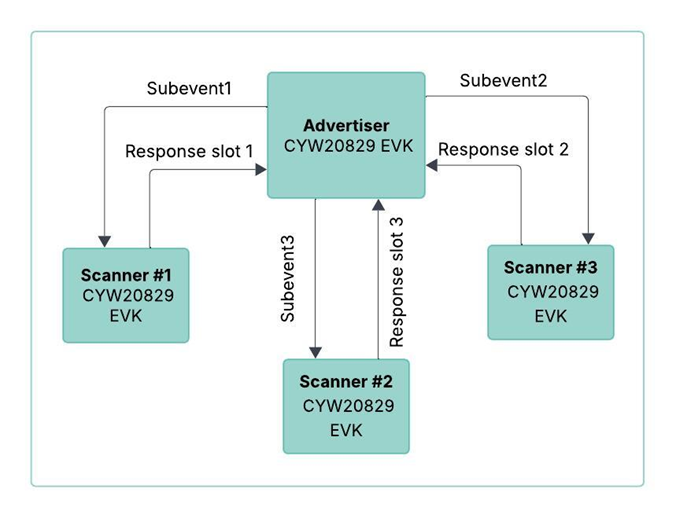
During my ongoing internship at Infineon, I implemented PAwR on the AIROC™ CYW20829 Bluetooth® LE SoC Evaluation Kit (CYW920829M2EVK-02), showcasing how synchronized communication can work flawlessly between one advertiser and three scanners. When activated by a button press, the advertiser starts periodic advertising, setting a structured rhythm for the network. Scanners synchronized with these periodic events broadcast by the advertiser, acknowledged signal reception by toggling LEDs, and transmitted real-time temperature data back during their allocated response slots. This system didn’t just exchange data—it operated with precision, creating a coordinated network where every device worked seamlessly together.
Where Zephyr meets PAwR: Synchronization in action
IoT communication often struggles with challenges such as efficiency, scalability, and reliability, but PAwR transforms this through its structured communication approach. By broadcasting periodic packets, the advertiser establishes a rhythm, dividing time into subevents and assigning response slots to ensure synchronized, collision-free communication.
This method of dividing time and assigning slots solves some of the biggest challenges in IoT networks such as data collisions, inefficiencies, and delays. By organizing communication into a predictable structure, PAwR ensures devices can exchange information seamlessly and reliably, even as your network expands. This structured approach is illustrated in Figure 1, showcasing the efficient and organized communication framework that PAwR establishes.
At the heart of PAwR is the advertiser, which periodically broadcasts advertising packets at consistent intervals. These intervals called events form the foundation of the network’s rhythm. Each event is further divided into smaller time blocks known as subevents, and each subevent contains response slots that are carefully assigned to individual devices.
What makes this approach so effective is its focus on collaboration without chaos. Devices respond exclusively during their assigned slots, which ensures communication stays organized and collision-free. This predictability eliminates the confusion caused by devices “talking over” each other, allowing for a smooth and efficient flow of data across the network.
By pre-scheduling communication through dedicated slots, PAwR not only prevents interference but also enables IoT networks to scale effortlessly. Whether you’re connecting a handful of devices or managing thousands, the system ensures everything remains synchronized and efficient, solving challenges that many traditional communication protocols struggle with.

Figure 1: PAwR timing diagram
In our project, we used 4 kits, leveraging one kit to program the advertiser project and the other three kits to program the scanner project for effortlessly demonstrating precise synchronization. On a button press, the advertiser started broadcasting periodic packets, managing communication across the network. The scanners responded within their designated slots, toggled LEDs upon successful synchronization, and seamlessly transmitted measured temperature data back to the advertiser. Zephyr RTOS played a vital role in making this process effortless by aligning periodic events and responses with its real-time capabilities. Its robust APIs further simplified working with Bluetooth, GPIO, and ADC functionalities, ensuring smooth data flow throughout the network.
Observing the system in action—advertisers setting the rhythm on a button press, scanners responding precisely, and data flowing seamlessly—highlighted the effectiveness of predictable timing, resulting in a highly coordinated, synchronized IoT network. This project showcased how PAwR and Zephyr RTOS together deliver scalable and reliable communication systems.
Bluetooth low energy: Precision in every packet
Bluetooth Low Energy (LE) has been a crucial enabler of IoT applications due to its low-power and reliable communication. With the introduction of PAwR in Bluetooth LE 5.4, its capabilities now extend further by enabling structured communication across thousands of devices. By organizing communication into periodic events, subevents, and response slots, PAwR eliminates interference and makes it easier to achieve scalability in IoT systems.
In this project, a button press initiated periodic advertising, creating predictable communication patterns. The advertiser periodically directed communication with three scanners playing their roles flawlessly without collisions. Scanners toggled their LEDs to confirm synchronization, collected temperature data using thermistors, and transmitted the data back in their assigned response slots. PAwR demonstrated how small, structured packets enable efficient and effective coordination across multiple devices, making it ideal for scalable IoT implementations.
PAwR: The rhythm of my system
PAwR feels like orchestrating a performance, where every device plays its part perfectly. The advertiser acts as a central hub, managing periodic events, subevents, and response slots, while the scanners synchronized themselves to the rhythm and transmitted data seamlessly during allocated slots, as shown in Figure 2. Here’s how the elements worked together:
- Advertiser: Triggered by a button press, the advertiser broadcast periodic events subdivided into precise subevents and response slots for efficient communication.
- Scanners: Each scanner was configured with a particular response slot, in order to send the data in its respective slot. The scanner synchronizes with the periodic packets transmitted by the advertiser and then sends the data, including the temperature measurement from the thermistor, in its assigned response slot, while toggling the LEDs to confirm synchronization.
- Temperature sensing via ADC: Scanners used thermistors to gather temperature data, converting the raw ADC readings into precise values, which were transmitted back to the advertiser during their allocated response slots.
With periodic events driving the system, the toggling LEDs and smooth data flow demonstrated how PAwR’s structured design ensures accuracy, efficiency, and scalability. It highlighted how careful organization and timing enable systems to operate with precision and flawless coordination.
Figure 2: System block diagram
Zephyr RTOS: Precision for PAwR
While PAwR provided the rhythmic structure for communication, implementing it successfully was made possible by Zephyr RTOS. Zephyr simplified the process of building this synchronized system with its modular design, real-time capabilities, and robust Bluetooth stack. The framework allowed the system to handle synchronization and control hardware smoothly without added complexity, as illustrated in Fig. 3, which depicts the hardware setup comprising the four CYW920829M2EVK-02 evaluation boards, configured with one device as an advertiser and three as scanners.
Zephyr’s device tree abstraction allowed for seamless integration of hardware elements, such as thermistors and LEDs, into the system. On the CYW920829M2EVK-02, the prj.conf file was used to enable only necessary features like Bluetooth, ADC, and GPIO, ensuring the system remained lightweight and efficient. With Zephyr’s real-time precision, periodic events and responses were aligned flawlessly, enabling smooth and consistent operation of the entire network.
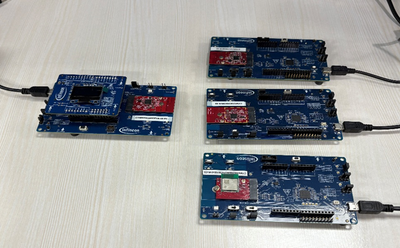
Figure 3: System hardware
Conclusion
Working with Bluetooth LE 5.4’s PAwR on the CYW920829M2EVK-02, backed by Zephyr RTOS, has been far more than a technical exercise—it has been a hands-on demonstration of how structured simplicity can create synchronized and scalable IoT systems. From periodic advertising triggered with a button press to seamless bi-directional communication, the project illustrated how reliable networks emerge from a balance of precision and system organization.
This internship at Infineon has reshaped my perspective on IoT. It showed me that IoT systems are no longer simply isolated devices but collaborative networks where devices operate together with synchronization and purpose. With tools like PAwR and Zephyr RTOS, the future of IoT lies in achieving elevated coordination, efficiency, and scalability.
Learn more about the CYW920829M2EVK-02 — Zephyr Project Documentation